All in for ...
2025 07 31
|
etc
no date
+ 2024
2025
index
home
There was a rally this evening hosted by my MPP Robin Lennox and Marit Stiles titled "All in for Ontario". There were signs. I did not take one. I wasn't sure if the event was a town hall or not as the event notification wasn't specific, so I'd prepared something to say on the off chance it was. It wasn't, but I gave Robin's gatekeeper the printed copy of my comments and notes. This is what I'd planned to say:
-
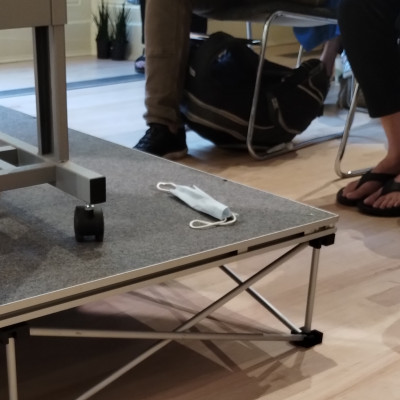
You'll notice I'm wearing a mask. I wore it not because I love to wear them, I don't. I wore it to show you one of the simplest forms of accessibility provision that anyone can partake in that barely anyone ever offers, requires, or advocates for. On that score, I'm happy to wear it, because one of the biggest disablers to a disabled person is not their disability, it's the society they live in - its lack of caring, lack of empathy and compassion, lack of inclusion, lack of accessibility, lack of even acknowledging the needs of the disabled, or even seeing disabled people as fully realised humans. As frustrating as you think providing accommodation is, I can assure you that having to navigate a world without them is much more frustrating - because sometimes that means we can't.
Disability isn't just a matter of the nature of a person's disability, it is also what a society does to the person, or deliberately doesn't provide for them, that disables them. On that note, does this event even have a Zoom option for those who can't attend in person? Because I saw nothing in the initial email invite nor confirmation. Did anyone even think about setting one up? There are people who can talk at greater length about the deliberate disabling of people a society no longer wants to acknowledge in a much more detailed and eloquent way than I can, but just think about the phrase "the weaker sex" and how it was - and still is - used as a tool to deliberately bar women from full participation. Think about that, the impact it has even to this day, the ease with which we label anyone lacking information as "stupid" when they're simply uninformed, and all of the othering terms used that deliberately undermine people based on their ability, gender, skin colour, or any other method we use to label, divide, other, and marginalise.
Disabled people make up between 25 to 30% of the population of this nation, and that's just the people who know they're disabled or will even acknowledge it. Many people won't because of the stigma we so readily attach to disability in general, and to particular disabilities specifically. Ability is not the default we think it is. Every single human will experience disability of some form or other, be it permanently or temporarily, between cradle and coffin. And even if they don't, someone they care for will.
Disability has been used as an electoral talking point since the dawn of electoral politics, and that is the problem. Disability is not a side quest. It should never be used as someone's vote-getting tactic. Disabled people need actual community, support, allyship, and to be provided what they need to participate in this world as well as they would like to. We need a major shift in outlook here, to one where we acknowledge disability as the default and build our social and physical infrastructures accordingly. We need to stop accepting ableism as de rigueur, treat it the same way we'd like to see racism treated, and shift the focus off the faux moral superiority of those who punch down because they think it'll make them immune to disability.
No one is immune to disability no matter what they do. Disability does not care about your age, gender, sexual orientation, skin colour, religion, economic status, educational level, cultural background, nor anything else. It is the least discriminatory - and most intersectional - social category there is. Whether through birth defect, congenital condition, accident, injury, illness, or age, if disability wants you, it will come for you.
These are some random notes I'd attached to the printed material:
- Accessibility. This helps everyone - it helps disabled people, and those who help them. The attitude needs to shift from one where accommodations that exist to make life more accessible for disabled people are no longer seen as things that make life less accessible for others. Someone getting something you don't get, does not mean you're suffering. It just means they aren't.
- Work. While there are certainly many negatives regarding gig work, it actually is a better option for people with certain disabilities and illnesses. If we switch how labour works from a time-based to task-based method (like some online work options utilise), that will provide more access to work for people with conditions that prevent them from working a continuous 9-5/40 hr work week. More people could work, assuming there were jobs to do, if the way the work functioned was altered.
- The idea of deliberate societal exclusion when it comes to disability is far more insidious than the average person realises. One advocate discusses that you do not have to bring back something like ugly laws (that existed in the US) in order to exclude disabled people, you just have to keep them too poor to participate. We all know that that absolutely holds true in Canada as well, given the dismal funding disabled people are expected to live on.
How poetically sad that, given the content of my comments, that this was randomly left on the podium: